Where to Buy Genuine Sunmi POS in Pakistan – Distributor and Partner Guide 2026
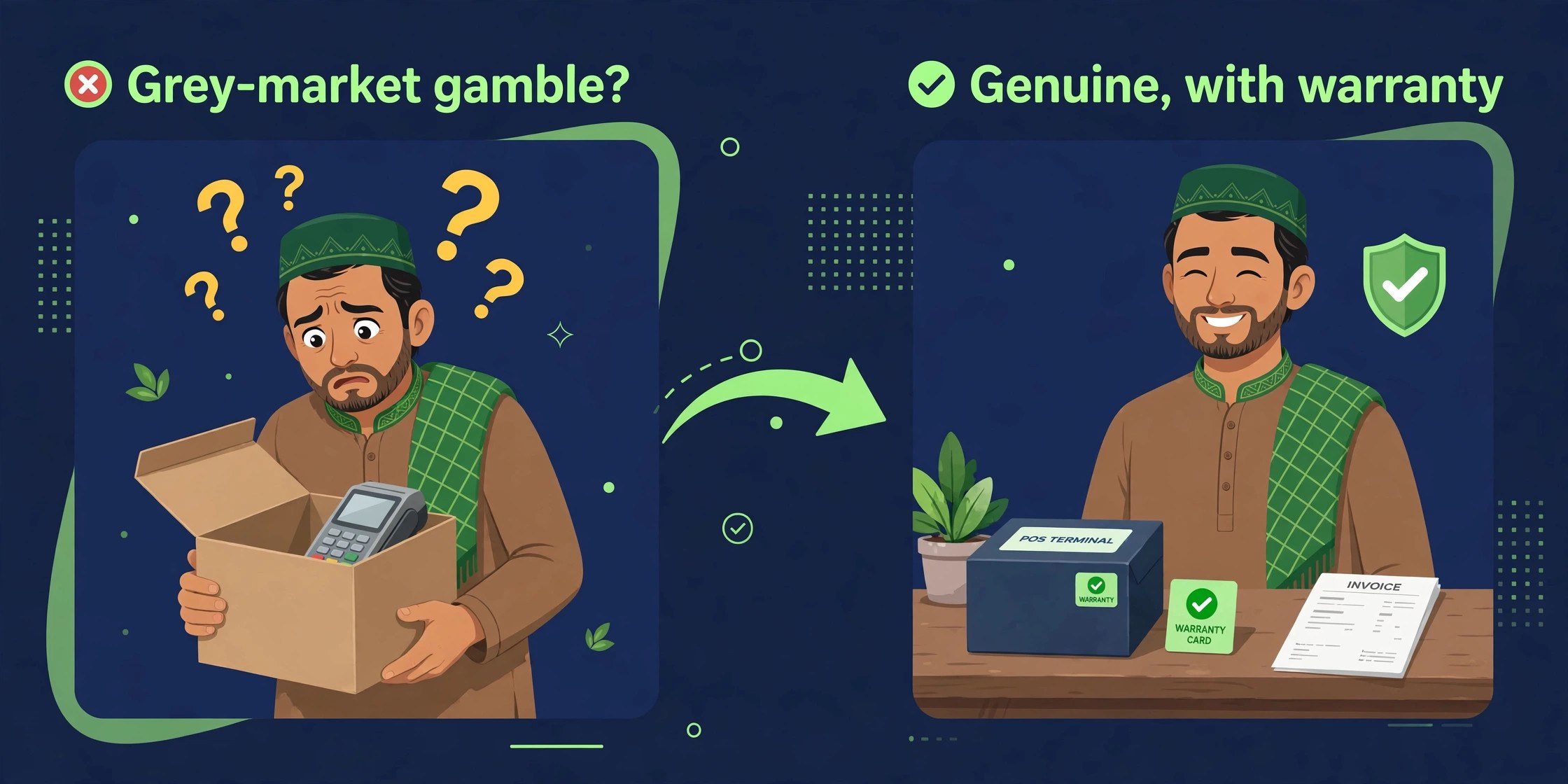
If you have searched for a Sunmi distributor in Pakistan, you already know the confusing part: everyone sells the box, nobody clearly explains what you are actually buying. This guide fixes that. It covers where genuine Sunmi devices come from, how authorized channels differ from grey-market sellers, how to verify a device before you pay, and what the warranty really covers.
One thing to get straight first: Sunmi works through a global partner network — over 73,000 partners across 200+ countries, by Sunmi's own count — not through a single national distributor with a public certificate. So the question is not really 'who is THE distributor.' The question is how to tell a proper channel from a risky one. That is what this guide answers.
Why the seller matters as much as the model
A POS terminal is not a phone. When your billing counter stops working at 8pm on a Friday, you don't need a helpline in another country — you need a company in your city that picks up, has spare parts, and honors the warranty. The device on the box is identical; the after-sales reality is entirely determined by who sold it to you.
- —Warranty path — a proper seller gives you a local desk for claims; a grey seller gives you a promise with no address.
- —Region and firmware — devices meant for other regions can arrive with the wrong firmware or missing local payment certifications.
- —After-sales and spares — printers jam, batteries age, screens crack. Local stock means days, not months.
- —Invoice and recourse — a purchase invoice in the seller's name is your only leverage if something goes wrong.
The three places Sunmi devices actually come from in Pakistan
Strip away the marketing and every offer you see falls into one of three channels. They are not equal, and the price differences between them are not random.
| Channel | What you get | The catch |
|---|---|---|
| Established distributor | Local stock, warranty desk, purchase invoice, genuine sealed units, guidance on the right model | Priced to carry the warranty reserve — never the cheapest quote |
| Reseller / retailer | Genuine units bought through distribution, shop you can walk into | Warranty still routes through their supplier — ask who that is |
| Grey market — OLX, Facebook, direct import | Lowest price, sometimes genuine units | No warranty path, no invoice, no recourse; refurbished units sold as new are common |
None of this is theoretical. Grey-market POS hardware is a known problem worldwide — the standard advice from POS buying guides is blunt: buy from verified sellers or official channels, because the red flags are always the same.
How to check a Sunmi device is genuine before you pay
Do this before money changes hands, whether you are buying one unit or fifty:
- 1Serial number and warranty card — every genuine unit ships with both. No serial, no deal.
- 2Sealed retail packaging — standard Sunmi packaging, not a repacked box.
- 3Boots into SUNMI OS — the device should start into Sunmi's own Android build with the Sunmi App Store present. A unit that cannot boot into factory settings is a walk-away signal.
- 4Purchase invoice in the seller's name — not a handwritten receipt, an invoice from the company.
- 5The warranty question — ask 'if this fails in month four, exactly where do I take it and who pays for the repair?' and judge the answer, not the smile.
The one question that settles it
Forget certificates and claims. Ask the seller: 'If this device fails in month four, exactly where do I take it, and who pays for the repair?' A proper distributor answers in one sentence with an address. Everyone else changes the subject.
The warranty reality in Pakistan
Sunmi's own product manuals state the standard plainly: one year from the date of purchase, claimed through the warranty card, and voided by unauthorized repair, tampered seals, or water and drop damage. Keep your receipt and serial number together — the manuals ask for both.
Here is the part sellers skip: the claim travels through your seller, not to Shanghai. Your warranty is only as real as the company standing behind it. An 'international warranty' from a seller with no local desk is a promise with no address — when the device fails, you will be the one shipping it abroad, paying for it, and waiting.
- —Ask where claims are handled — a city and a phone number, not 'we will manage.'
- —Ask what the warranty excludes — batteries and printers wear; know the terms before you need them.
- —Get it in writing — the warranty terms on the invoice, not in a chat message.
Why the same model costs different amounts in different shops
A genuine, locally-stocked unit carries real costs behind the price tag: import duties, local stock, and the warranty reserve that funds the repair desk. When the same model is dramatically cheaper somewhere else, the discount came from somewhere — and it is never the seller's generosity.
- —Grey imports — brought in outside official channels, no local warranty behind them.
- —Refurbished units sold as new — the classic OLX special.
- —Older regional stock — previous-generation units or region variants at clearance pricing.
- —No warranty reserve — the seller simply isn't budgeting for your month-four failure.
The red flags, collected from POS buying guides and our own experience: an unusually low price, a missing serial number, non-standard packaging, and a device that cannot boot into factory settings. Any one of these is enough to walk away.
The device is only one of three purchases
This is the mistake we see most often: a business buys the device, then discovers the counter still doesn't work. Hardware, software, and integration are three separate purchases — and they fail independently.
- —The device — the Sunmi terminal. Buy it from someone with an address and a warranty desk.
- —The software — the POS application with billing, inventory, and reporting. Licensed or subscribed, with a support team behind it.
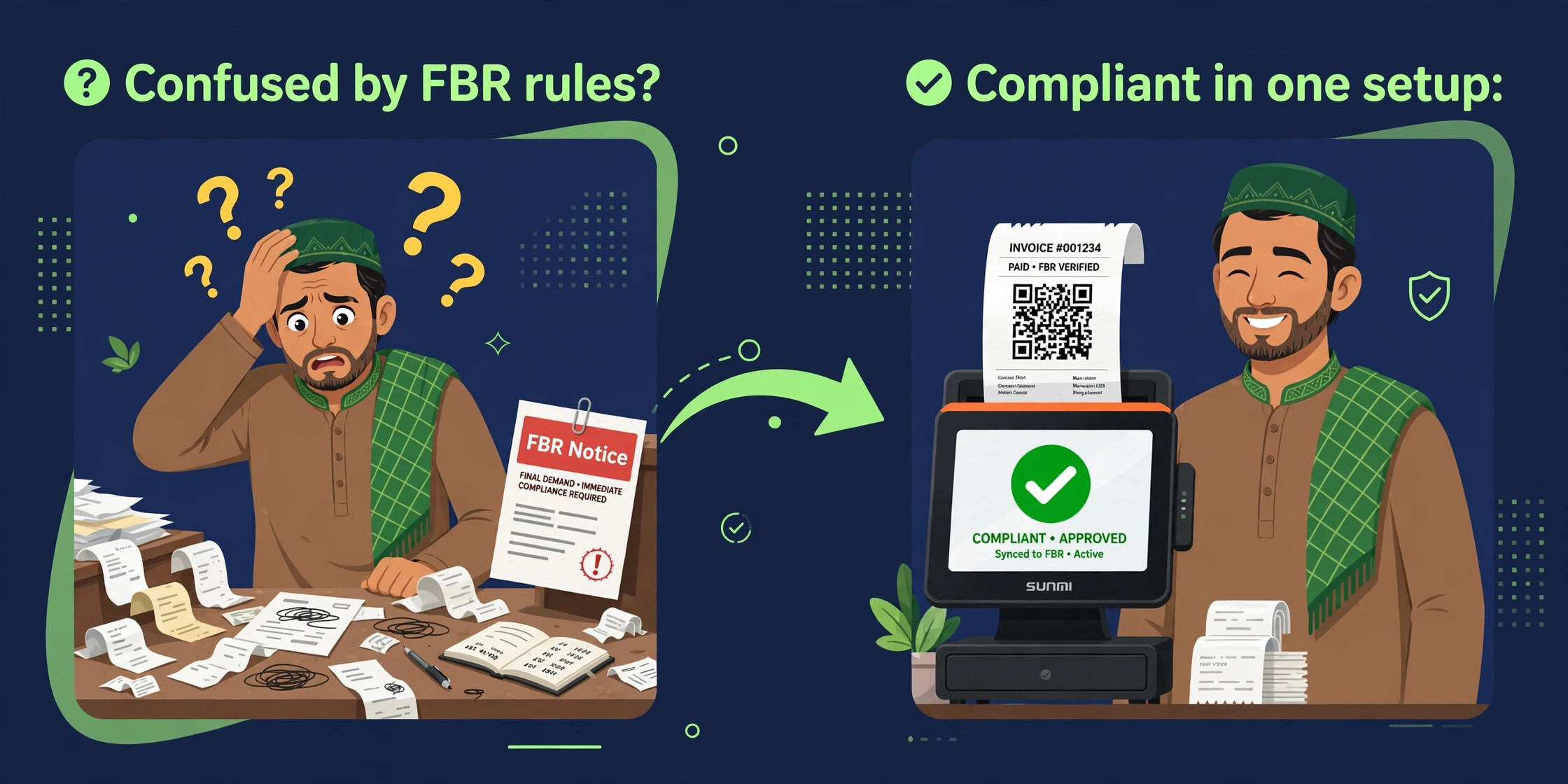
- —The integration — FBR-ready configuration, QR-code receipt printing, staff training, and someone who answers the phone when the dinner rush breaks something.
Don't buy software from a box-seller with no integration practice, and don't buy hardware on a software vendor's scare pitch. Our FBR e-invoicing guide covers the compliance half in detail, and our per-device guides match each Sunmi model to the counter it suits — read those before you spend anything.
Where Sabsons and Sabsoft sit in this picture
Plain disclosure, since this guide lives on our site: Sabsons is our group's hardware distribution company — it supplies Sunmi hardware in Pakistan with local stock, proper invoices, and warranty handling. Sabsoft is the integration and software company — device setup, FBR-ready configuration, and support. One group, two lanes, no confusion about who does what.
You can buy the device from one lane and the integration from the other, or take both in one contract. What we will not do is pretend the device alone makes your counter work — or sell you integration on hardware we can't stand behind.
Comparing Sunmi models before you buy?
Our per-device integration guides cover the V3, T2, V2s and cloud printer — specs, best-fit businesses, and what the integration includes.
The short version of this whole guide: buy the device from someone with an address, the software from someone with a support desk, and the integration from someone who answers the phone. Everything else is detail.
Device plus integration, in one contract
Sunmi hardware supply through our group, plus setup, FBR-ready configuration, QR-code receipt printing and staff training from Sabsoft — for restaurants and retailers across Pakistan.
Want FBR-ready billing without a custom project?
Sabify is our group's packaged SaaS POS — FBR-ready invoicing from PKR 3,000/month, running on Sunmi hardware. No integration project required.